
Your Strategy for 2026:
How Team Alignment Plays
a Critical Role in Its Success
Introduction
As businesses set their strategies for 2026, one question looms large: will your team be ready and willing to execute that strategy? Crafting an ambitious strategic plan is only half the battle – the real challenge is ensuring your people are aligned behind it. In the corporate world, continual growth and adaptation are necessary to stay ahead of the competition, and to neglect growth is to risk falling behind[1]. But even a brilliant strategy can falter if your teams are not moving in the same direction. This is why team alignment – getting everyone from leadership to the frontline on the same page – plays a critical role in whether your 2026 strategy succeeds or stalls.
Today’s business environment is fast-changing and complex. New technologies, market disruptions, and evolving work practices (like hybrid and remote setups) mean that organisations must be more agile than ever. Frequent shifts in direction can make it harder for teams to maintain focus. In fact, a recent global report found that two-thirds of enterprises rank lack of alignment with business strategy as a top challenge in execution[2]. Simply put, if your people don’t clearly understand the strategy or their role in it, even the best-laid plans can go awry. In the sections below, we’ll explore what team alignment really means, why it’s so crucial for achieving strategic goals, and how you can foster greater alignment in your organisation – including subtle ways that training and development initiatives can help along the way.

Phil Gibbins
Commercial Director
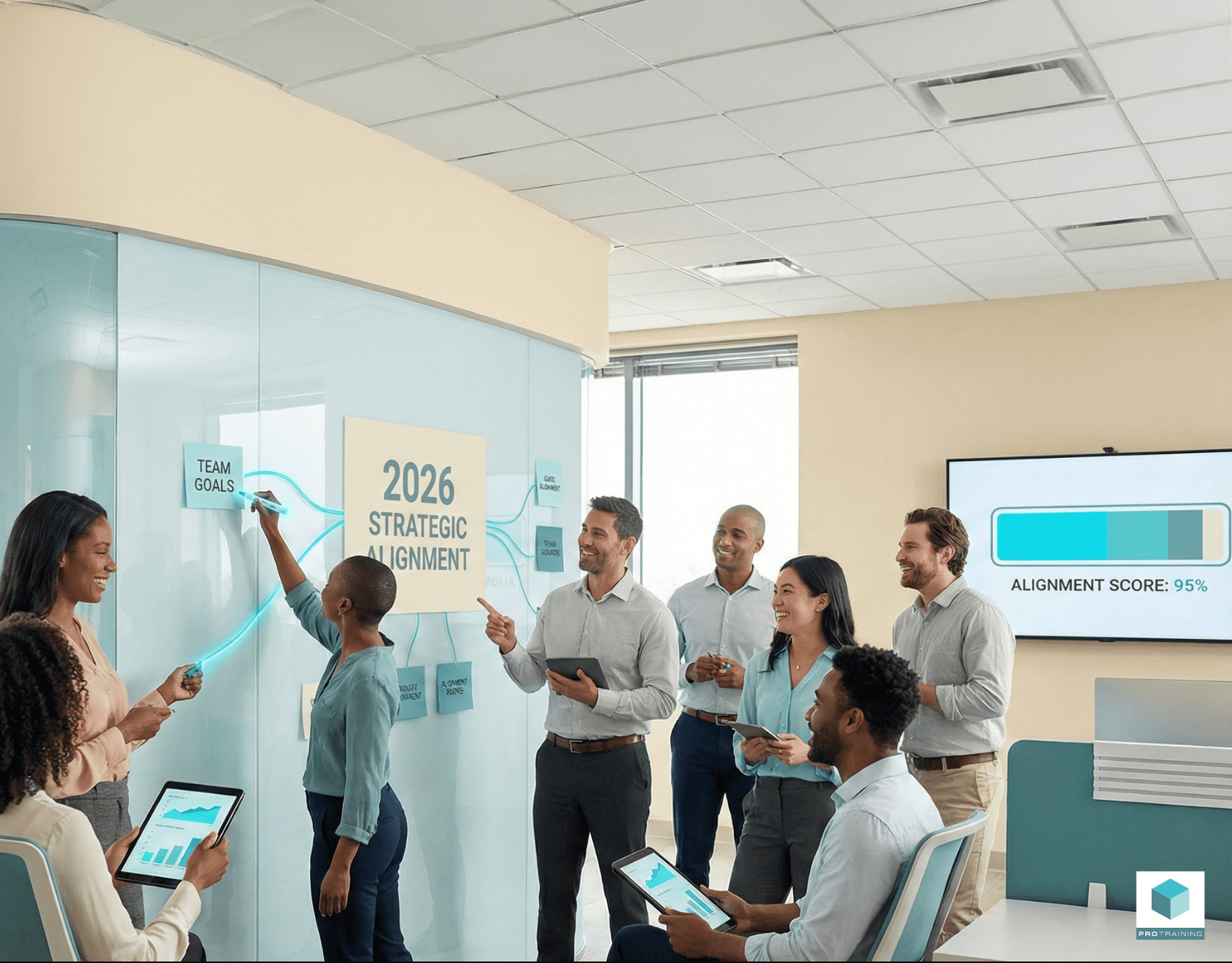
What Does Team Alignment Really Mean?
Team alignment means that everyone in the organisation is working in sync toward the same strategic objectives. It’s often described as having a shared vision, common goals, and clarity on how each individual contributes their strengths to achieve them[3]. When a team is aligned, members understand not just what needs to be done but also why it matters to the broader mission. There is a clear “line of sight” from the daily tasks each person does, up through team and departmental goals, all the way to the high-level strategy. In an aligned team, Marketing isn’t chasing one agenda while Product Development or Operations chase another – they are all pulling in the same direction.
Alignment is closely linked with clarity and cohesion. A high-performing team typically exhibits both strong trust and strong alignment[4]. Trust is the belief that colleagues and leaders will follow through on commitments and act in the team’s best interest, while alignment is the clarity that “this is where we’re going, this is how we’ll get there, and this is what each of us will do”[5]. Both are necessary components of a successful team culture. In practice, achieving alignment means ensuring everyone understands the company’s vision and strategy for 2026,
and sees how their work fits into that picture. It’s not about forcing unanimous agreement on every detail – rather, it’s about creating a shared understanding so that even if individual viewpoints differ, the team can commit to a common path forward.
When people talk about alignment, they often mean strategic alignment (linking goals and execution) as well as cultural alignment (sharing the same values and priorities). Leaders have to align the mission and purpose of the organisation with its day-to-day operations. For example, if a company’s 2026 strategy emphasises innovation and customer experience, an aligned team will have every department – from R&D to customer service – aware of those priorities and coordinating efforts to support them. On the other hand, a misaligned team might see different departments working at cross purposes. Consider a scenario described by strategy expert Tony Ulwick: the marketing team optimises for awareness, the product team focuses on feature development, and the sales team pushes for quick wins – each “making rational decisions based on their own perspective,” yet inadvertently undermining the overall strategy[6][7]. Alignment is about breaking down these silos so that all teams collaborate towards achieving the same common goal.
If your team keeps misfiring on the same kind of work — strategy nobody implements, plans that miss deadlines, or initiatives that lose energy halfway through — the underlying issue is often a missing or duplicated team role, not motivation. A Belbin 360 team-role profiling workshop maps each member’s preferred contributions against what the team actually needs, which usually surfaces the gap in under an hour.
Why Alignment Is Critical for Strategic Success
Lack of team alignment is one of the silent killers of great strategies. Studies have found that well over half of strategic plans fail not due to a bad strategy, but because of poor execution – in fact, about 67% of well-formulated strategies fail due to poor execution[8]. The primary culprit for poor execution is often a disconnect between leadership’s intentions and what teams actually do on the ground. If people are unclear about the strategy, or if middle managers interpret it in conflicting ways, execution breaks down. Essentially, a strategy on paper is worthless if your team isn’t aligned to carry it out.
One of the biggest issues is the alignment gap that can exist between the top and bottom of an organisation. Leaders may come out of the boardroom feeling aligned on a brilliant new strategy, but that doesn’t guarantee that the rest of the organisation understands it. A Harvard Business Review analysis revealed a striking disconnect: while executives reported feeling 82% aligned with their company’s strategy, actual measured alignment among employees was only 23% – a gap nearly threefold between perception and reality[9]. This kind of misalignment is costly. When strategies aren’t clearly communicated and reinforced at every level, teams may inadvertently pursue different priorities or revert to old habits, derailing the strategic plan.
On the flip side, high alignment yields high rewards. Organisations that manage to achieve true alignment stand to significantly outperform their competitors. Research indicates that companies where everyone is pulling in the same direction are about 30% more profitable than peers[9]. Similarly, a study of 410 companies found that highly aligned organisations grew their revenue 58% faster and were 72% more profitable than misaligned organisations[10]. These are staggering differences. The improvements come from multiple fronts: aligned teams execute tasks more efficiently, waste fewer resources, and respond to changes more coherently. When strategy and execution are in harmony, every part of the business reinforces the other parts. For instance, product development builds offerings that sales can sell, sales promises align with marketing messages, and customer service feedback loops into strategy adjustments. This cohesion drives better performance across the board.
Even at the level of day-to-day team operations, alignment brings tangible benefits. When people share the same vision and goals, you tend to see improved productivity and communication, higher morale, lower staff turnover, and greater agility in adapting to changes[11]. Team members are more motivated because they see meaning in their work and know how it contributes to the bigger picture. Decisions can be made faster because there’s clarity on priorities – people don’t have to second-guess whether an action fits the company’s vision or strategy. In short, alignment acts as a performance multiplier. It creates a work environment where everyone knows the game plan and their part in executing it, which in turn boosts confidence and results.

Conversely, the costs of misalignment can be severe. Misaligned teams often duplicate work, miss opportunities, or work at cross purposes. A classic example is the rift that sometimes occurs between sales and marketing: poor coordination and misaligned goals in these functions cost businesses upwards of $1 trillion annually in lost productivity and wasted effort according to research by G2[12]. When one part of the organisation is out of sync with another, it’s like a rowing team where each person paddles to a different rhythm – the boat merely spins or stalls. Common symptoms of misalignment include projects that don’t deliver expected outcomes, teams blaming each other for missed targets, or strategic initiatives that start with fanfare but fizzle out due to lack of follow-through. In a global benchmark study on strategy execution, about 33% of professionals cited “lack of alignment between strategy and execution” as a top barrier to success[13] – nearly on par with other barriers like slow decision-making. All of this underscores that aligning your team is not a “nice to have” – it’s a fundamental requirement for strategic success. In 2026’s competitive landscape, organisations simply can’t afford the drag factor of an unaligned workforce.
For teams whose alignment problems show up specifically around resource allocation — too many priorities, not enough hands — the Coral Banks strategic team building simulation puts teams into a scenario where their resource decisions immediately affect the group’s collective performance. It’s particularly effective with leadership teams that already think they’re aligned.
How to Achieve Team Alignment with Your 2026 Strategy
Achieving team alignment is an ongoing leadership effort – it’s not a one-time task but a continuous process of communication, reinforcement, and adjustment. As you formulate and roll out your 2026 strategy, here are several practical steps to ensure your team remains aligned and focused on the goals:

Communicate a Clear Vision and Strategy: First and foremost, make sure the strategic vision for 2026 is crystal clear and well-communicated. This means distilling the strategy into an understandable narrative that answers “Where are we going and why?” and sharing it broadly. Avoid jargon and articulate the core goals in a way that resonates with all levels of staff. Some companies create a simple one-page strategy summary or slogan that encapsulates the plan. The key is that every employee should grasp the big-picture vision. Remember, if people don’t understand the strategy, they can’t align with it. It can be helpful to use visual frameworks or town-hall meetings to drive the message home. For example, strategy consultants often recommend tools like a one-page strategic plan to “put everyone on the same page” and establish a common language for goals and values[14]. Don’t assume a single email or presentation is enough – reiterate the vision often, and tie everyday decisions back to it.
Connect Individual Roles to Strategic Goals: Alignment happens when each team member sees how their work contributes to the wider goals and objectives. It’s crucial to break down the high-level strategy into concrete team and individual goals (for instance, through OKRs or departmental KPIs) so that people know exactly what their priorities are and how those priorities support the strategy. Encourage managers to discuss strategic alignment in one-on-one’s and team meetings: employees should be able to answer, “How does what I’m working on help achieve our 2026 targets?” When goals are cascaded properly, everyone can draw a direct line from their to-do list up to the company’s mission. This also means clearing up conflicting objectives. If, say, the strategy emphasises customer satisfaction over pure volume, ensure the sales team’s targets and incentive structures reflect that, rather than pushing a metric that could undermine service quality. By aligning metrics and rewards with the strategy at every level, you create consistency. As a result, people are not just busy, but busy with the right things.
Many alignment failures aren’t about goals at all — they’re about working styles colliding silently in meetings and inboxes. The Styles At Work behavioural profiling team activity gives team members a vocabulary for their differences, which is usually enough to turn a recurring friction point into a manageable conversation rather than an ongoing irritation.


Foster Cross-Functional Collaboration and Communication: Siloed teams are the enemy of alignment. To get the whole organisation moving together, promote strong communication across departments. Create forums for cross-functional teams to share progress and challenges, ensuring everyone understands how their work impacts others. Regular inter-departmental meetings or project check-ins can surface misalignments early on – for example, marketing and product teams might coordinate on ensuring that product features align with the marketing promises being made. Establishing a rhythm of communication is critical; one best practice is implementing daily or weekly huddles and updates to keep teams coordinated[15]. In fact, many scaling companies use a structured meeting cadence (daily stand-ups, weekly tactical meetings, quarterly reviews, etc.) to maintain alignment as they execute their strategy[15]. These aren’t meetings for meetings’ sake – when done right, they ensure information flows quickly and everyone stays on the same page. As Verne Harnish’s Scaling Up methodology suggests, a short daily huddle can prevent minor issues from snowballing and keep teams aligned in real time[16][17]. Beyond meetings, encourage a culture where departments proactively reach out to each other when plans or assumptions change. The fewer surprises between teams, the better aligned the organisation will be.
Cultivate a Culture of Trust and Accountability: Alignment is reinforced by the culture within the team. Leaders should strive to build trust – both in leadership decisions and among team members – because trust is the glue that holds alignment together. When there’s trust, people are more likely to buy into the strategy and less likely to second-guess or resist new initiatives. Conversely, when trust is low, it can take three times longer to embed new strategic initiatives and get everyone rowing in the same direction[18]. To improve trust, leaders need to be transparent, follow through on what they say, and encourage open dialogue. It’s also important to set clear expectations (sometimes called “agreed team behaviours”) and hold everyone accountable to them. If a team has agreed on the game plan, then each member – from senior executives to individual contributors – should be accountable for executing their part. Recognise and celebrate people who exemplify the company values and support the strategy, as this reinforces desired behaviours. By building a high-trust environment with a shared sense of responsibility, you make it much easier for alignment to take root and for coordinated action to happen naturally.


Be Ready to Adapt and Realign Quickly: In today’s environment, strategies may need to evolve even within the year. New competitors, technologies, or economic shifts can arise in 2026 that require a tweak to your plan. Highly aligned organisations are usually also nimble – they can pivot because their teams are used to adjusting in unison. To achieve this, establish processes to review progress and realign frequently. For example, use quarterly strategy check-ins to assess what’s working and what’s not, and then communicate any shifts in direction clearly across the company. When changes happen, explain the why behind them so that employees remain engaged rather than confused. The goal is to avoid the scenario where frontline staff are left executing last quarter’s plan while leadership has secretly moved on to a new priority. If you cultivate an agile mindset and maintain transparency, your team will be more comfortable adjusting their sails together. As one survey noted, frequent strategy changes are a top roadblock for many organisations[2] – but those that have mastered alignment treat change as a coordinated effort, not a series of disjointed reactions. Plan to re-align as you go; alignment is not a one-and-done deal but a continuous journey.
Alignment doesn’t mean absence of disagreement — high-performing teams disagree constantly but channel it productively. The gap between healthy debate and a stalled team is usually one or two unresolved interpersonal patterns, which is exactly what our conflict management training for cross-functional teams is designed to surface and resolve.
Invest in Training and Development Aligned to the Strategy: People drive strategy, so their skills and understanding need to match the plan’s demands. Targeted training, coaching and team-building initiatives can significantly boost alignment. For example, if your strategy involves adopting a new technology or process in 2026, organise training sessions to get teams up to speed and confident in using it. If collaboration or leadership agility is needed, workshops or courses in those areas can prime your team for success. Moreover, collective training experiences can ensure everyone hears the same messages and learns the same frameworks. According to one leadership institute, getting your key team members to participate in the same training programme is one of the best ways to get everyone on board with strategic changes quickly[19]. Joint training creates a common language and understanding that team members can carry into their daily work. Even team-building exercises can play a role: well-designed team activities and business simulations can equip your team with the skills required to tackle future challenges in your organisation[20]. Such experiential learning not only improves individual capabilities but also reinforces the behaviours and teamwork your strategy needs (for example, learning how to solve problems together or communicate better under pressure). Professional training and consulting firms, like PROTRAINING, specialise in these kinds of corporate programmes – offering short courses, business simulations and workshops that develop team skills, enhance performance, and align behaviours with organisational goals[21][20]. Importantly, these interventions should be closely tied to your strategic priorities so that employees can immediately translate learning into action on the job. By investing in your people in this way, you’re essentially future-proofing your strategy execution capacity – making sure your team not only understands the strategy but is fully capable of delivering on it.


Alignment in Action: A Real-World Example
A real-world case shows how powerful team alignment can be. Marlo Furniture, a leading US retail company, undertook an organisation-wide effort to improve alignment as they scaled up their business. They realised that as their workforce grew, keeping everyone focused on the same objectives was becoming challenging. So, Marlo’s leadership implemented a series of practices to get all employees on board with the company’s goals. They introduced clear scoreboards and forecasting tools visible to everyone, established a disciplined meeting rhythm (including daily huddles and weekly review meetings), and crucially, they invested in regular all-hands training. In fact, every quarter the company would literally close all its stores for half a day to hold a training programme for all 500 associates[22]. During these sessions, they would present a slideshow reinforcing the company vision, review “big rocks” (key priorities), celebrate last quarter’s achievements, and lay out plans for the next quarter. Managers even set up booths in a fair-like format so employees could learn how each division was contributing to the business and what their critical metrics were[23]. This interactive approach ensured that everyone from sales clerks to warehouse staff understood how the business ran and how their role fit into the larger strategy.
Organisations looking to improve customer satisfaction and frontline communication can benefit from our frontline customer service training, designed to enhance customer experience, service standards, and employee engagement.
The results of Marlo Furniture’s alignment efforts were impressive. In just six months, the company saw a 20% reduction in non-sales staff payroll costs (reflecting efficiency gains) while revenues actually increased[24]. Even more striking, managerial staff turnover – which had been a troubling 30% – plunged to just 2%, indicating a huge boost in team morale and commitment[24]. Other metrics improved as well: inventory turned faster and customer satisfaction climbed, evidenced by an increase in customers willing to refer Marlo to friends from 80% to nearly 100%[25]. These outcomes speak to the power of alignment. By making sure every employee understood the strategy, had a voice in the process, and could see performance feedback (through scoreboards and open discussions), Marlo created a culture of shared accountability. People weren’t operating in the dark or at cross purposes; they had clarity on goals and real-time information on progress, which enabled quick corrective actions when needed[26]. This case study underscores that alignment isn’t just a feel-good concept – it delivers concrete business results. When a team is truly aligned, the organisation can achieve more with the same resources, employees stay longer and contribute more enthusiastically, and the company can adapt more smoothly to challenges. It’s a virtuous cycle: success breeds further alignment and engagement, which breeds further success.
Conclusion: Align Now for a Successful 2026
As you finalise your strategy for 2026, remember that even the most visionary strategy will succeed or fail based on the people executing it. Team alignment is the critical bridge between strategy formulation and strategy execution. It’s what turns abstract plans on a whiteboard into tangible results in the market. The encouraging news is that alignment is under your control as a leader. By communicating clearly, breaking down goals, fostering trust, and investing in your team’s development, you can create an organisation where everyone is rowing in unison toward your 2026 objectives.
Most alignment problems live at the seams between functions — the place where one team’s deliverable becomes another team’s input and everyone insists they did their part. The Promises, Promises cross-functional alignment activity makes those handoffs visible by forcing teams to negotiate and deliver against each other, which is exactly where the everyday breakdowns start.
It’s also worth noting that you don’t have to do it all alone. Many organisations partner with training and consulting experts to kick-start their alignment efforts – for instance, running strategy workshops, leadership coaching, or team-building sessions to build momentum. PROTRAINING is one such partner that provides integrated learning solutions to help develop better strategies, behaviours, and performance within teams. Their philosophy of experiential learning and continuous growth reflects a simple truth: when your people grow, so does your business. Ultimately, achieving team alignment is a journey, not a one-time event. It requires attention and nurturing, but the payoff is a team that can execute faster, adapt to change more smoothly, and drive the results that your strategy envisions.
In 2026, businesses will face no shortage of new challenges and opportunities. Those companies that manage to align their teams around a common purpose, equip them with the right skills, and engage them fully in the mission will have a distinct advantage. They will be more resilient in the face of disruptions and more decisive when time is of the essence. As the saying goes, “culture eats strategy for breakfast” – and alignment is a big part of that culture equation. By building a culture of alignment now, you put your organisation in the best possible position to translate your 2026 strategy into success. The strategy points you in the right direction; an aligned team gets you to the destination. Here’s to your organisation’s aligned, energised march toward its 2026 goals!
Few team activities expose alignment gaps as cleanly as the Gold of the Desert Kings planning and execution simulation — most groups spend so little time on shared planning that the execution phase becomes a study in why aligned teams outperform smart individuals, every single time.

Sources:
- PROTRAINING – Corporate Training and Courses in Dubai (Homepage)[1][20]
- Workpath – Why Alignment and Outcome-Driven Strategy Execution Define Enterprise Success[9]
- Strategyn (Tony Ulwick) – The Team Alignment Problem Killing Your Growth Strategy[8][10]
- The Leadership Sphere – Why Do You Need a High Performing Team in 2026?[4][5][18]
- Growth Institute – Why Your Company Can’t Afford to Ignore Team Alignment[11][15][22][24][19]
- Planview – Global Benchmark Study: The State of Strategy Execution 2025[13]
- G2 (via Workpath) – Report on Sales and Marketing Alignment[12]
[1] [20] [21] Corporate Training and Courses in Dubai UAE | Training Institutes
[2] [9] [12] Why Alignment and Outcome-Driven Strategy Execution Define Enterprise Success | Workpath Magazine
https://www.workpath.com/en/magazine/alignment-and-outcome-driven-strategy-execution
[3] [11] [14] [15] [16] [17] [19] [22] [23] [24] [25] [26] Why Your Company Can’t Afford To Ignore Team Alignment
https://blog.growthinstitute.com/scale-up-blueprint/team-alignment
[4] [5] [18] Why Do You Need a High Performing Team in 2022?
https://theleadershipsphere.com.au/insights/why-do-you-need-a-high-performing-team-in-2026/
[6] [7] [8] [10] The Hidden Alignment Problem Killing Your Growth Strategy | Strategyn
https://strategyn.com/the-team-alignment-problem-killing-your-growth-strategy/
[13] Global Benchmark Study: The State of Strategy Execution 2025
https://www.planview.com/lp/strategy-execution-benchmark-prm/