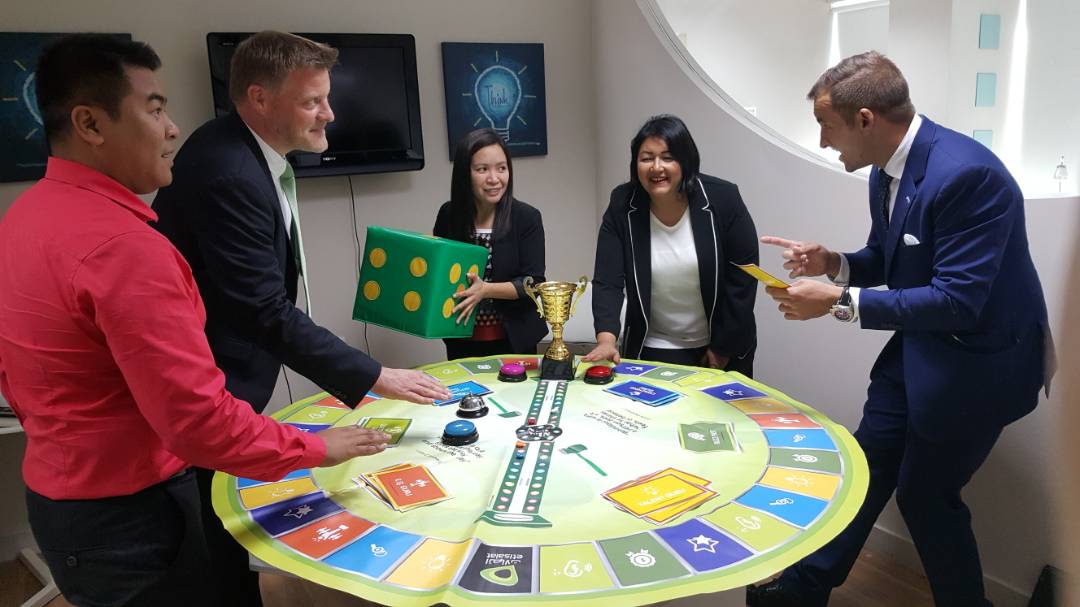
Experiential learning methods are given the utmost importance in most professional fields. For instance, the crux of training of armed forces and medical personal is based on simulations. Clearly, there is a great need to practice in a safe environment before there are high stake risks involved.
Why then shouldn’t the simulation teaching strategy be applied in business? Why shouldn’t you use business simulations to train the people working for you and get the most out of them? If it works for pilots, police, and other professions, it would surely be effective for your organisation too.
What Is A Business Simulation?
Before you adopt a simulation teaching strategy in your organisation, you should understand it better.
So, what is a business simulation? And how can it help you out? Business simulations refer to an interactive learning experience. The participants use their theoretical knowledge practically in a risk-free environment during this teaching programme.
This not only clears their concepts but also enables them to get a better understanding of business strategy. They learn how to react to particular situations and use their conceptual knowledge in the business world.
Simulation teaching strategy builds skills and leads to better productivity and performance. To put it in simpler terms, it is the link between learning and real-life experiences.
Think about it. An employee might have the best knowledge. Yet he panics in a particular situation as he hadn’t encountered it before. Would his knowledge be of any use?
Business simulations prepare the candidates for probable upcoming events. It enhances their decision-making skills. Thus, in the future, they are more likely to take steps that will benefit your organisation in the face of a crisis instead of panicking.
Simulations work because they let teams fail safely on problems that mirror what they’ll face on Monday morning. The Customer Drive frontline customer service simulation puts service teams through a compressed business cycle where every choice — from triage to escalation to recovery — ripples through customer loyalty scores, giving them a felt sense of cause and effect that no slide deck delivers.

Why Use A Business Simulation?
So it’s now clear what a business simulation is. The question is, is it worth the effort to use business management simulation for your organisation? Should you invest in training your employees via these teaching methods?
Undoubtedly!
Surely you don’t want to end with a bunch of employees who have excellent conceptual knowledge but don’t know how to implement it. Business simulations are your best bet to take your company forward.
For customer-experience teams, the proof of a simulation is whether participants change behaviour the following week. The Tactic Travel customer centricity simulation drops teams into a service business where every internal decision shows up in customer outcomes — and the after-action debrief is usually where the real learning lands, when participants see exactly how their well-intentioned choices created the problem they spent the morning fixing.
Here’s what business management simulation can offer;
For one thing, business simulations imitate reality. The strategy focuses on teaching your employees how to deal with challenges that often come your organisation’s way. The simulation teaching strategy will prepare your employees for what lies ahead.
Business management simulation is done in a risk-free environment. This allows employees to learn from their mistakes without worrying about losing their jobs. After all, you can’t expect everyone to have rational thinking during a crisis. However, if they have learned how to deal with such a situation before during their training, they wouldn’t panic.
Simulation teaching strategy gives the employees a chance to mingle with each other and form a bond. A peer-to-peer learning environment is created. The employees realise that they are part of the same team and are encouraged to cooperate with one another.
Studies have proven that we merely remember 10% of what we read. Up to 20% of the stuff we hear is retained in our memory. 70% of what we learn during discussions remains with us. And most importantly, 80% of our knowledge comes from personal experience.
Business simulations give the employees a chance to experience the consequences of their actions. They learn about the situations they might have to face as a part of your organisation and prepare accordingly.
Business management simulation is hands-on learning. All senses are put to use during this training. The participants have to;
- Visualize a particular situation
- Discuss among them
- Plan a strategy
- Receive feedback
- Practice techniques used in the workplace
Simulation teaching strategy enhances the learning of the participants. They learn various concepts and materials within a short span. This knowledge is highly beneficial for your organisation.
Situational leadership in practice requires more than knowing which style to use — it requires the conversational skill to switch registers naturally and help each team member grow over time. Our coaching skills for situational leaders programme gives managers the practical toolkit to develop people at every stage of competence and commitment.
The ROI argument for business simulations becomes much sharper when you look at specific engagement examples — including the kind of work Tazmin Walker, who leads many of our simulation engagements, runs with regional finance and operations leadership teams.
s
Importance Of A Business Simulation?
By now, you must have realised how profitable the simulation teaching strategy can be for your organisation. It is not uncommon for companies to incur heavy losses due to the wrong decisions of the employees. Indeed, sometimes the loss is so high that it takes a long time to recover from the blow.
Among the simulations that consistently deliver the strongest ‘next-day applicability’ feedback, the Countdown project management business simulation sits at the top of the list — partly because almost every manager has a stalled project they recognise within the first 30 minutes of the session, and partly because the toolkit walks straight out of the room into their actual project plan.
However, can you really blame the employees for it? They hadn’t faced such a situation before. They made a decision based on their understanding. But, the problem is that there is a vast difference between the practical world and bookish knowledge. What seems to be ideal in books might completely backfire in the real world.
Business simulations ensure that your business doesn’t suffer due to the employees. You can prepare them for the real world. The most significant benefit of the simulation teaching strategy is that it wouldn’t cost your company anything. Even if the employee makes a grave error, your organisation will remain unscathed.
Isn’t this the reason that experience is given so much importance in the business world? You assume that since the candidate has been a part of the business community for long, he wouldn’t buckle under pressure.
Business simulations can be counted as experience. However, along with this experience, you can also get fresh minds brimming with ideas. It is indeed a win-win situation.
Which organisation wouldn’t want employees they can rely on to make the right decisions? Business simulations make sure that your company gets to greater heights. It ensures that every employee becomes a valuable asset to the team.
Of all the business simulations we run, project management formats tend to deliver the fastest return because the gap between ‘people know the theory’ and ‘people can actually run a project’ is so wide.
If your teams are missing deadlines or scope-creeping every initiative, our project management courses and simulations in Dubai bundle the Countdown® simulation with practical workshops so managers leave with tools, not just frameworks.
Solution?
Theoretical knowledge is excellent, but one needs to learn how to put it to practical use. What is a business simulation? The teaching strategy makes it easier for candidates to learn how they can implement what they have learned.
Do you want to enhance your employees’ decision-making skills? Do you want to teach your employees the strategies to adopt in the real world? Do you want to ensure that your organisation does not suffer a loss due to employees’ errors? Business management simulation is what you need.
Innovation programmes that don’t shift behaviour usually fail at the leadership level — senior teams say they want bold ideas but signal otherwise in how they react under pressure. The Vulcanus open innovation simulation for leadership teams compresses an innovation cycle into a single session, making those reactions visible in real time so the team can talk about them honestly.
Teach your employees how to react under pressure and take timely actions. It will improve productivity significantly and will prove to be worth the effort.
If team building is going to drive vision, growth and action in your organisation, the format has to match the outcome you’re after — a quick energiser won’t fix strategic misalignment, and a multi-day offsite is overkill for a quarterly team meeting. We’ve put together our full range of corporate team building activities in Dubai with each one tagged by the business outcome it’s designed to produce, so you can pick by goal rather than by gimmick.
See Our Simulations Below
They are now available virtually with our facilitator-led online sessions.